Welcome back to the series “What Should You Study to Stay Relevant?” Today, let’s explore a topic that is receiving significant attention from students and young people: What do businesses expect from young talents in the age of AI?
In recent years, Artificial Intelligence (AI) has become increasingly familiar. AI is gradually appearing across almost every field, from marketing, finance, and logistics to education, media, and customer service. As a result, the way businesses operate, recruit, and build teams is changing faster than ever before.
How Is AI Changing Recruitment and Business Operations?
There is no denying that AI is creating pressure on the global labor market. Recently, many technology and financial companies have carried out workforce reductions to optimize operations through AI and automation. Block has cut more than 4,000 employees, WiseTech plans to reduce around 2,000 jobs, Citigroup aims to cut 20,000 positions, while Goldman Sachs predicts that AI could eliminate between 5,000–10,000 jobs per month in the finance and banking sector.
However, if we look more closely, this is not entirely a story of “AI taking away jobs.” In reality, the labor market is shifting into a new phase where businesses prioritize individuals who can adapt and work effectively alongside technology.

According to the LinkedIn Future of Work Report, AI-related job postings are increasing by more than 30–40% annually across many major markets. Meanwhile, the World Economic Forum identifies AI & Big Data as the fastest-growing skill group globally for the 2025–2030 period. The PwC AI Jobs Barometer also shows that jobs requiring AI-related skills are experiencing stronger salary growth and hiring demand than the general market average.
In Vietnam, AI adoption is also accelerating rapidly. Fields such as digital marketing, data analytics, logistics, fintech, and cybersecurity are increasingly demanding professionals who understand technology and can work effectively in digital environments. This demonstrates that businesses do not necessarily expect all students to become AI experts or programmers. More importantly, they value the ability to adapt, understand technology, and work effectively in AI-supported environments.
What Do Businesses Expect from Students in the AI Era?
In the past, many companies mainly recruited based on degrees or academic scores. Today, what matters more is a candidate’s practical working ability.
One of the most important requirements is the ability to apply technology effectively. Whether studying marketing, logistics, accounting, or hospitality management, students today need to become familiar with digital platforms, management software, and AI tools that support work processes.
For example:
- Marketers use AI to analyze customer behavior and create content
- Logistics professionals use data to optimize supply chain operations
- Accounting and finance increasingly rely on management software and automated data systems
What businesses truly need is no longer simply “understanding AI theory,” but rather knowing how to apply technology to work more efficiently.

Besides technology, foreign language proficiency has also become almost essential. AI may support translation, but communication skills, international teamwork, global thinking, and negotiation are still areas where humans play a critical role. In modern businesses, English is no longer just an advantage—it is gradually becoming a foundational skill that helps students access new knowledge and expand career opportunities.
In addition, businesses today place high value on soft skills and practical experience. Many students with strong GPAs still struggle professionally because they lack communication skills, critical thinking, teamwork, or problem-solving abilities. This remains one of the biggest gaps between classroom theory and real working environments.
Another increasingly important factor is the ability to self-learn and adapt. AI changes continuously, and technology evolves constantly. Therefore, the people with the greatest future advantage may not necessarily be those who “know the most,” but rather those who can learn quickly, adapt quickly, and continuously update their knowledge.
Studying at NIIE: Preparing Students with Exactly What Businesses Need
In response to labor market changes, the educational model at NIIE Institute has been developed with a strong focus on practical application, helping students engage with real working environments earlier rather than concentrating solely on theory.
Students at NIIE study in a bilingual environment with an English learning pathway aimed toward the B2 standard (IELTS 5.5–6.0), helping them develop the ability to use English naturally in both academic and professional contexts. This also provides an important foundation for working in international environments and adapting to the digital era.
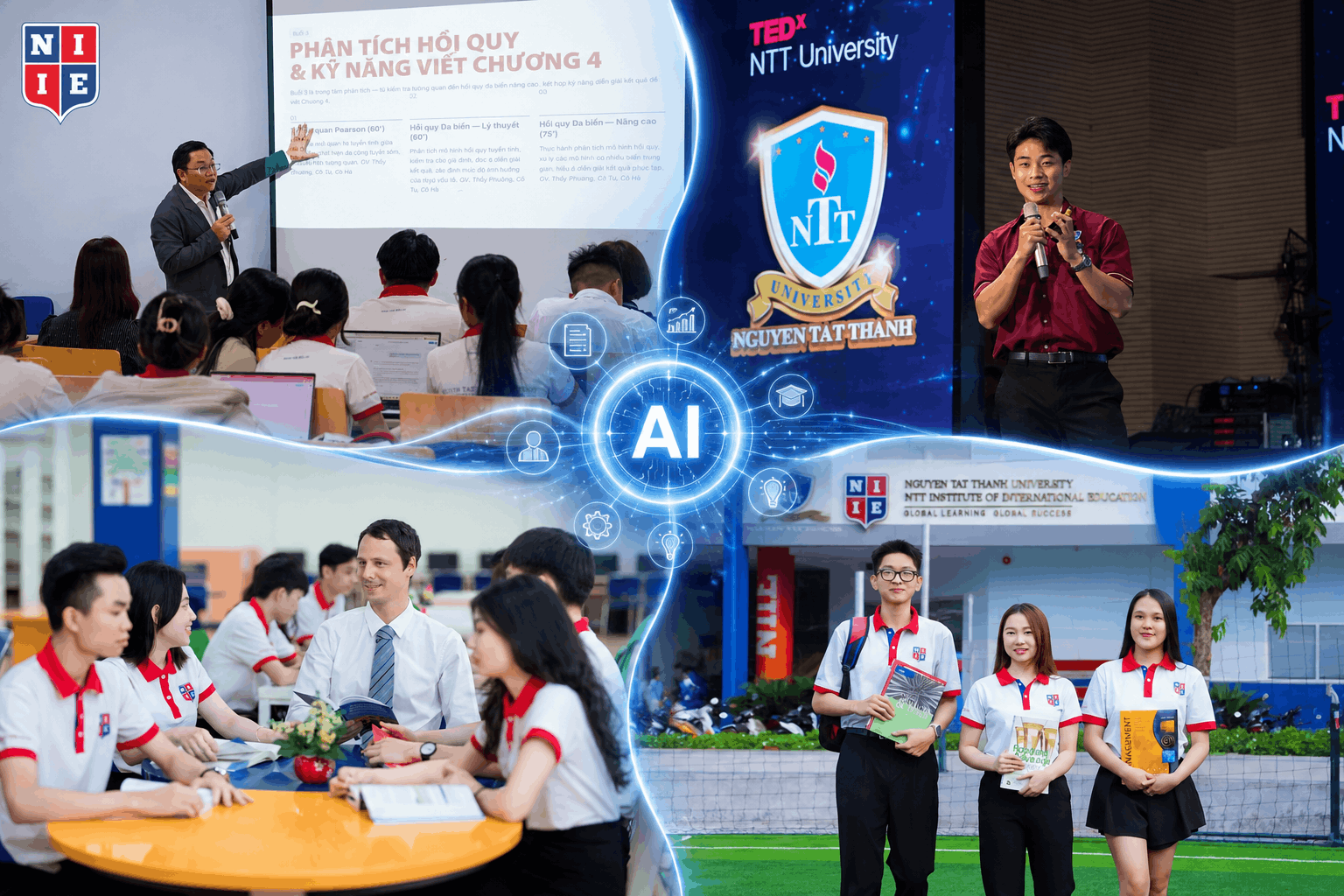
In addition, NIIE strongly promotes workshops, seminars, project-based learning, and learning alongside industry lecturers. Instead of only studying textbook knowledge, students are exposed to real-world case studies, project work, and practical business situations.
The S.T.A.R training pathway at NIIE is also designed to support students through each stage—from orientation and adaptation to action and career readiness. Alongside professional knowledge, students develop communication skills, critical thinking, teamwork, and the ability to apply technology in real work settings.
Furthermore, enterprise engagement activities and internships are integrated throughout the study journey. This gives students opportunities to observe real working environments, understand career expectations, and gain experience early.
In the AI era, businesses no longer wait until students graduate before retraining them from scratch. Therefore, preparing early through a practice-oriented learning environment is becoming increasingly important for today’s young generation.
Choosing the Right Learning Environment to Avoid Being Left Behind
AI will undoubtedly continue reshaping the labor market in the years ahead. However, opportunities will always remain open for those who can adapt, possess practical skills, and maintain a lifelong learning mindset.
Therefore, the question “What should you study to stay relevant?” is not only about choosing the right major, but also about choosing the right environment that helps you develop the skills needed for the future.
If you are looking for a learning environment focused on application, early enterprise exposure, and the development of professional knowledge, English proficiency, and practical skills, you can learn more about the programs at NIIE Institute – Nguyen Tat Thanh University at: https://xettuyen.niie.edu.vn